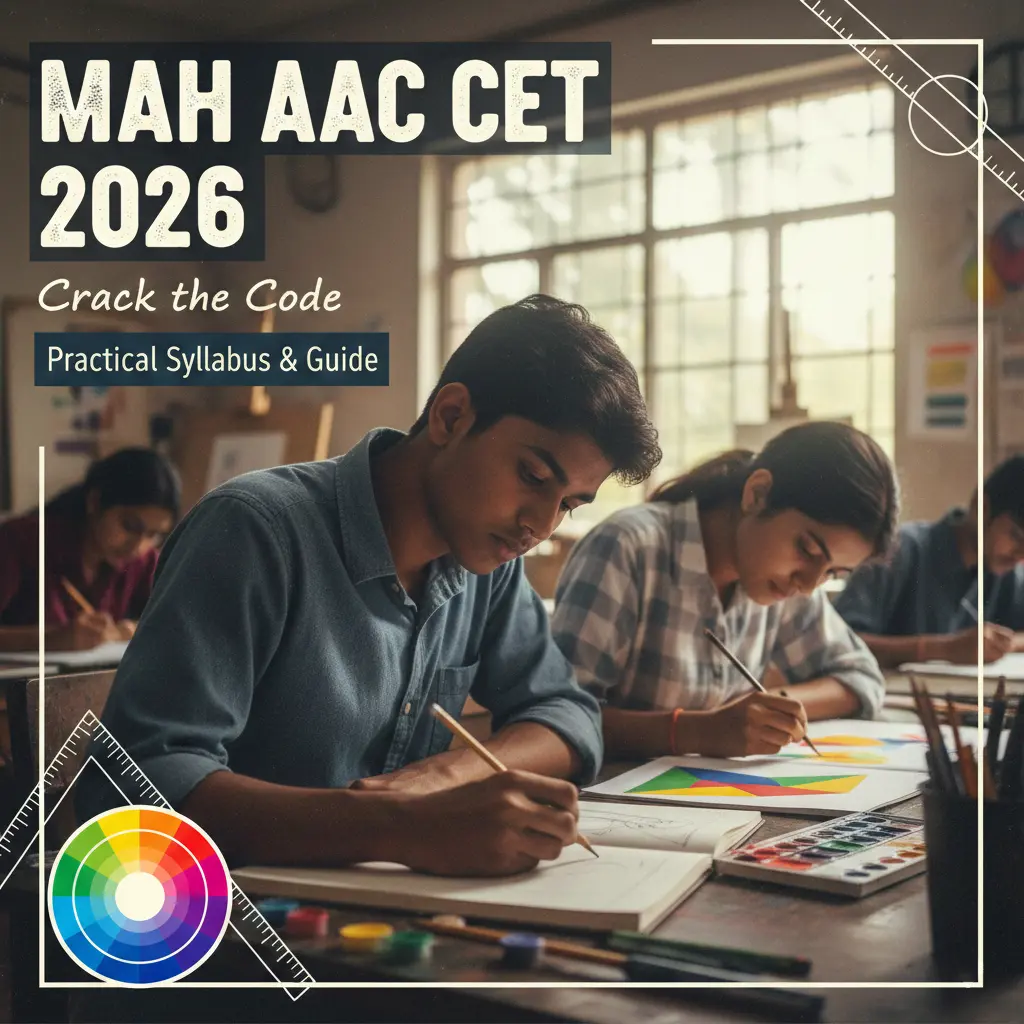
MAH AAC CET 2026 is the official entrance examination for admission to Applied Arts and Craft (BFA) courses in Maharashtra. If you’re planning to appear for the exam on 10 April 2026, understanding the syllabus and exam structure clearly is essential—especially because this exam is practical-heavy and very different from written CETs.
This guide explains the MAH AAC CET syllabus 2026, section-wise papers, marks distribution, duration, and what examiners actually look for—without unnecessary downloads or promotional clutter.
What Is MAH AAC CET 2026?
MAH AAC CET (Maharashtra Applied Arts and Craft Common Entrance Test) is conducted by the State CET Cell, Maharashtra for admission to Bachelor of Fine Arts (Applied Arts) programs offered by government and aided art colleges in the state.
Unlike design aptitude exams, MAH AAC CET focuses more on:
Drawing skills
Visual observation
Memory and imagination
Basic art theory knowledge
The exam is designed to test how well a student observes, thinks visually, and expresses ideas through drawing, rather than speed-based problem solving.
MAH AAC CET 2026 Eligibility Criteria (Expected)
To appear for AAC CET 2026, candidates must generally fulfill the following conditions (based on previous years):
Passed or appearing in HSC (10+2) or equivalent examination
Students from any stream (Arts, Science, Commerce) are eligible
No compulsory art background required
Maharashtra State candidature rules apply for seat allocation during CAP rounds
Eligibility rules are usually released officially with the information brochure, but these conditions remain largely stable every year.
MAH AAC CET Exam Pattern 2026 (Expected)
The exam consists of four papers, out of which three are practical and one is theory-based.
Overview of Papers
| Paper | Type | Marks | Duration |
|---|---|---|---|
| Design Practical | Practical | 50 | 1 hour 30 minutes |
| Object Drawing | Practical | 50 | 1 hour |
| Memory Drawing | Practical | 50 | 1 hour 30 minutes |
| Objective Theory (GK) | Theory | 40 | 1 hour |
| Total | 200 marks | 5 hours |
This structure has remained consistent in previous years and is expected to remain similar for MAH AAC CET 2026.
MAH AAC CET Syllabus 2026 – Section-Wise Breakdown
Design Practical – 50 Marks
This paper evaluates your creative thinking and basic design understanding, not artistic perfection.
You are tested on:
Creative use of design principles
Balance, symmetry, rhythm, and composition
Use of colours and colour harmony
Aesthetic sense and functional design thinking
Basic use of geometrical tools
Awareness of different colour mediums and techniques
What examiners look for:
Clear ideas, neat presentation, logical composition, and confident colour usage.
Object Drawing – 50 Marks
This paper tests your observation and proportion skills.
You may be asked to draw:
Man-made objects (bottles, tools, utensils)
Natural objects (fruits, leaves, stones)
Key focus areas:
Accurate proportions
Correct placement on paper
Light and shade differentiation
Clean pencil rendering
Artistic detailing is less important than accuracy, structure, and observation.
Memory Drawing – 50 Marks
Memory drawing checks how well you can visualize and recreate scenes from memory.
The syllabus focuses on:
Observation of daily life scenes
Imagination and visual storytelling
Proportional sketching
Perspective (near vs far objects)
Environmental and social awareness
Typical prompts involve:
Market scenes
Festivals
Public places
Everyday activities
This paper rewards students who observe life consciously, not those who rely on imagination alone.
Objective Theory (General Knowledge) – 40 Marks
This is the only theory paper in MAH AAC CET 2026 and is objective-type.
Topics include:
Fundamentals of art (line, shape, colour, texture)
Colour theory (primary, secondary, tertiary colours)
Famous art monuments (India & world)
Renowned painters and sculptors
Basics of design, craft, and visual arts
Elementary computer graphics awareness
Questions are straightforward and factual, not analytical.
MAH AAC CET 2026: Number of Questions & Evaluation
The theory paper typically consists of 40 objective questions, carrying 1 mark each
Practical papers are evaluated based on:
Concept
Execution
Proportion
Creativity
Presentation quality
There is no negative marking in MAH AAC CET.
Drawing Mediums & Materials for MAH AAC CET
Based on previous exams, candidates are generally expected to work with:
Pencils (for object & memory drawing)
Poster colours / water colours (for design practical)
Brushes, scale, eraser, sharpener
Digital tools are not allowed. Clean sheets, clear margins, and controlled colouring make a strong impression on evaluators.
How Examiners Evaluate Practical Papers
Many students lose marks not due to lack of skill, but due to wrong priorities.
Examiners usually value:
Clear idea over decoration
Correct proportions over heavy shading
Balanced composition over complex elements
Neat presentation over excessive detailing
A simple, well-executed drawing scores higher than a complicated but confusing one.
Common Mistakes to Avoid in MAH AAC CET
Overcrowding the drawing space
Ignoring proportions while focusing on shading
Using too many colours unnecessarily
Weak composition in memory drawing
Poor time management between papers
Avoiding these mistakes alone can significantly improve your final score.
Colleges Accepting MAH AAC CET Scores
Admissions through MAH AAC CET are offered by:
Government and aided art colleges in Maharashtra
Institutes in Mumbai, Pune, Nagpur, Aurangabad, and other regions
Seat allotment is done through CAP rounds conducted by the State CET Cell
How to Prepare Smartly for MAH AAC CET 2026
Practice daily sketching from real objects
Draw from memory at least twice a week
Revise basic colour theory and art fundamentals
Observe surroundings actively (people, spaces, activities)
Focus on clarity over decoration
Unlike competitive exams, MAH AAC CET rewards consistency and observation, not shortcuts.
Final Note
The MAH AAC CET syllabus 2026 is stable, practical-focused, and entirely manageable if approached correctly. Students who practice observation, drawing consistency, and basic art theory regularly tend to score significantly higher than those who rely only on last-minute preparation.
If you treat drawing as a daily habit rather than an exam task, MAH AAC CET becomes one of the most predictable and fair entrance exams in the applied arts domain.
1 Comment
web site
25/03/2026Probar un casino online con pagos all instante puede hacer que la experiencia sea muco más cómoda.
Para muchos usuarios, contar con cobros casi inmediatos añade confianza al proceso.
Además, los sistemas financieros modernos
facilitan cada paso. Al combinar procesos transparentes con una interfaz cómoda, todo resulta más eficiente.