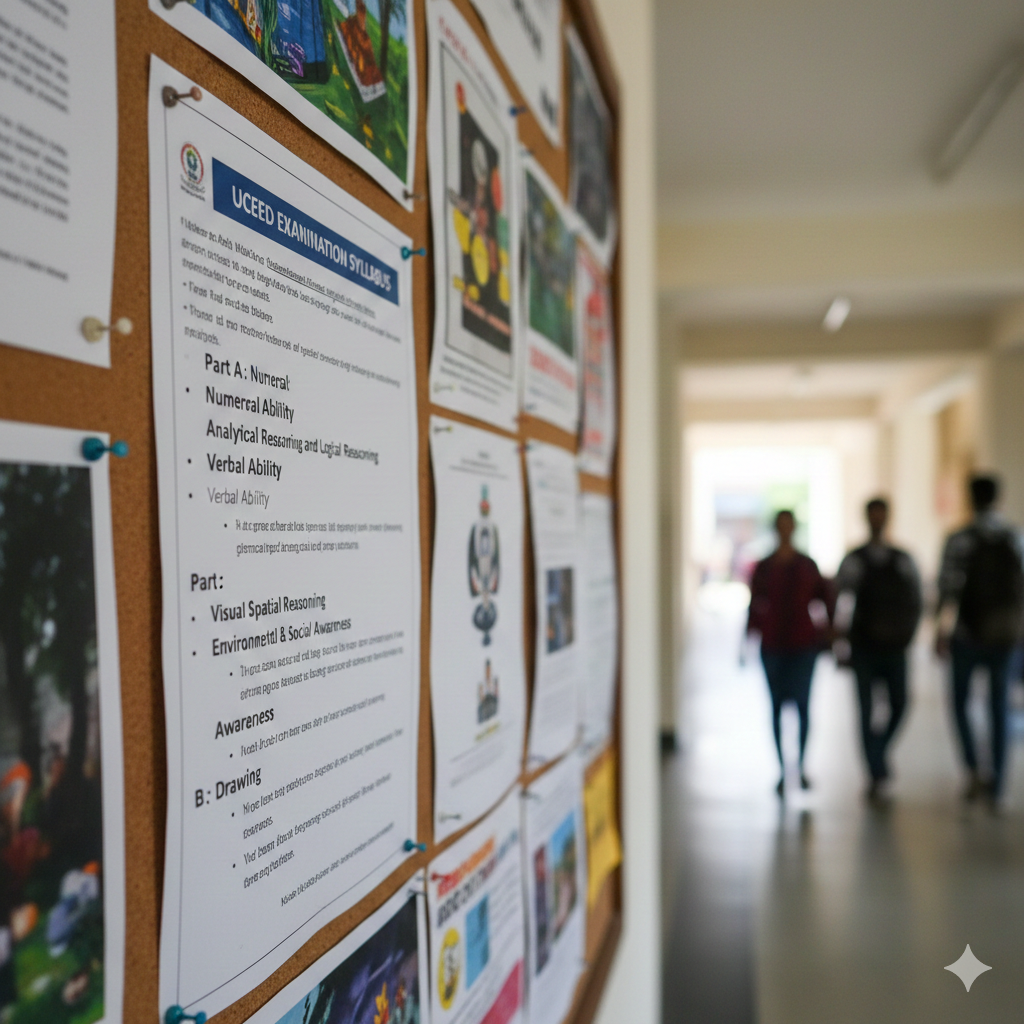
Are you aspiring to join prestigious design programs offered by IITs and other top institutions in India? The Undergraduate Common Entrance Exam for Design (UCEED) is your gateway. Understanding the comprehensive UCEED examination syllabus is the crucial first step towards successful preparation. This detailed guide will break down the UCEED 2025 syllabus into its core components, Part A and Part B, offering an in-depth look at each topic to help you formulate an effective study strategy. Whether you’re just starting your preparation or looking for a detailed checklist, this article provides the essential information you need to excel.
Understanding the UCEED Examination Structure
The UCEED examination is meticulously designed to assess a candidate’s aptitude for design. It comprises two main parts: Part A, which focuses on cognitive and analytical abilities, and Part B, which evaluates drawing and creative skills. Both parts are critical, and a balanced preparation strategy covering the entire UCEED examination syllabus is paramount for securing a good rank.
UCEED Examination Syllabus 2025: Part A – Aptitude and Analytical Skills
Part A of the UCEED exam is a computer-based test (CBT) that evaluates a wide range of abilities essential for design thinking. This section carries significant weightage and requires strong conceptual understanding and practice. Here’s a detailed breakdown of the topics:
Visualization and Spatial Ability
- Pictorial and diagrammatic questions to test understanding of transformation and/or manipulation of 2D shapes and 3D objects.
- Knowledge of scale and proportion, orthographic projections, and the ability to visualize various sides of 3D objects.
- Identifying unique forms from combinations of forms.
Observation and Design Sensitivity
- Ability to detect concealed properties in ordinary things, people, situations, and events.
- Awareness of environmental conditions, social and cultural contexts, and user-centric design principles.
- Understanding the impact of design on daily life.
Environmental and Social Awareness
- General knowledge about current events, globally recognized designers and design companies, history of art and design, and environmental concerns.
- Awareness of famous buildings, products, and brands, as well as socially and environmentally responsible design.
Analytical and Logical Reasoning
- Ability to look at information, understand relationships, and identify patterns and trends.
- Skills in reasoning, decision-making, and critical thinking.
- Problems related to numbers, words, figures, and their relationships.
Language and Creativity
- Ability to comprehend and articulate thoughts in standard English.
- Understanding of grammar, punctuation, and descriptive text.
- Creative thinking, generation of ideas, and understanding of visual metaphors.
Design Thinking and Problem Solving
- Application of design thinking principles to solve various problems.
- Understanding the stages of problem-solving, from identification to ideation and conceptualization.
- Ability to analyze given information and identify solutions.
UCEED Examination Syllabus 2025: Part B – Drawing and Creative Skills
Part B is a pen-and-paper test that assesses a candidate’s practical drawing and creative skills. This section evaluates your ability to communicate ideas visually and respond to design challenges. It is typically a single question designed to test multiple aspects of creative aptitude.
Drawing Skills
- Proportion and Perspective: Accurately representing objects in three dimensions.
- Composition: Arranging elements effectively within a given space.
- Shading and Rendering: Depicting light, shadow, and texture to give depth to drawings.
- Human Figures: Ability to draw human forms in various poses and actions.
- Object Drawing: Sketching everyday objects with attention to detail and form.
Creativity
- Imagination: Generating novel and original ideas.
- Innovation: Ability to think unconventionally and find unique solutions.
- Visual Communication: Effectively conveying concepts and narratives through visual means.
- Storytelling: Developing a visual narrative based on a given prompt.
Preparing for Success: Tips and Resources
Mastering the UCEED examination syllabus requires dedication and strategic preparation. Start early, familiarize yourself with the exam pattern, and practice consistently. For Part A, focus on solving previous year papers and mock tests to improve speed and accuracy. For Part B, regular sketching, practicing perspective drawing, and developing your observational skills are key. Consider enrolling in quality coaching programs or investing in well-regarded study materials to get expert guidance and comprehensive practice, which can significantly boost your chances of success.
FAQs about UCEED Syllabus 2025
1. Is the UCEED syllabus for 2025 different from previous years?
While the core structure and broad topics of the UCEED syllabus remain largely consistent year after year, minor updates or shifts in emphasis can occur. Candidates are always advised to refer to the official UCEED brochure for the specific examination year (e.g., UCEED 2025 brochure) to confirm the most up-to-date syllabus details.
2. What is the marking scheme for UCEED Part A and Part B?
UCEED Part A typically consists of three sections: Numerical Answer Type (NAT), Multiple Select Questions (MSQ), and Multiple Choice Questions (MCQ). Each section has a specific marking scheme, including negative marking for incorrect answers in some question types (like MSQs and MCQs). Part B is evaluated manually by examiners based on creativity, drawing skills, composition, and communication of ideas. The exact weightage for Part A and Part B, and the detailed marking scheme, are released in the official UCEED information brochure each year.
3. What kind of drawing skills are tested in UCEED Part B?
UCEED Part B primarily assesses your ability to visually communicate ideas. This includes skills such as freehand drawing, understanding of proportion and perspective, imaginative drawing, composition, sensitivity to form and texture, and the ability to tell a story or convey a concept through drawing. Candidates might be asked to draw objects from observation, imagine scenarios, or illustrate narratives.
4. How much time should I dedicate to each section of the UCEED syllabus during preparation?
The ideal time allocation depends on your strengths and weaknesses. Generally, a balanced approach is best. Since Part A is objective and covers multiple aptitude areas, consistent practice is vital. Part B requires continuous drawing practice to refine skills. Many suggest dedicating 60-70% of your time to Part A practice and conceptual understanding, and 30-40% to Part B drawing practice and creative exercises. Regular mock tests will help you identify areas needing more attention.
5. Are there any specific topics in Environmental and Social Awareness for UCEED?
While there isn’t a fixed list of topics, the Environmental and Social Awareness section broadly covers general knowledge related to design, art, culture, current affairs, famous designers, design history, and significant environmental issues. Staying updated with news, reading about design movements, and understanding contemporary social issues are good ways to prepare for this section. Focus on topics that relate to how design interacts with society and the environment.
Thorough knowledge of the UCEED examination syllabus is your roadmap to success. By understanding each component of Part A and Part B, you can create a focused and effective study plan. Remember, UCEED is not just about rote learning; it’s about honing your innate design aptitude, creativity, and problem-solving skills. Start your preparation today, practice diligently, and you’ll be well on your way to achieving your design aspirations.